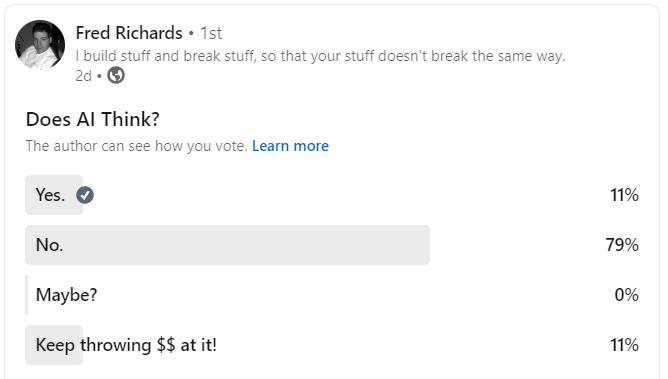
A few days ago, over on LinkedIn, a friend, Fred Richards, posted a poll question. Does AI think? 11% of people said “Yes” while the “No” camp took home 79% of the vote. “Maybe” stood alone with 0% of the vote while the remaining 11% said, “Keep throwing $$ at it!”
Granted, the poll was all in fun. At least, I assume it was. Nevertheless, I gave my answer (I was one of the 11% yes votes), but with an explanation. First, I explained, we need to argue about what intelligence means, so let me give it a try.
Intelligence is the ability to use information in order to accomplish tasks. The more intelligence, the more complex the problems/tasks that can be solved/achieved. In that respect, almost every form of life is intelligent to varying degrees. So is a calculator, or my Roomba. Does having intelligence imply thinking? That’s an open question. If we define thinking as sifting through information in an intelligent way to choose a specific solution to a problem, then yes, AI does think. Is AI conscious? Well, that’s a whole other topic than either intelligence or thinking.
And that’s where I left my answer, but the more I thought about it, the more I wanted to say, so I’m saying it here.
You’d be hard pressed to find a universal definition of intelligence, or what constitutes intelligence. Even today, there are several prevailing schools of thought on the subject. One of my favorites is Howard Gardner’s multiple intelligences theory, which suggests that there are eight distinct types of intelligence, linguistic, logical-mathematical, spatial, musical, bodily-kinesthetic, interpersonal, intrapersonal, and naturalistic. It’s one of my favourites if only because of its heroic effort to include anything a human being might be capable of as “intelligence”.
It also goes a long way, for now at least, to excluding machines, whether robot or computer, from participating in the intelligence game.
For machines, some people will suggest the Turing test, by which they usually refer to the thought experiment proposed by computer pioneer, Alan Turing. The actual Turing test is almost certainly irrelevant since most modern chatbots can pass it easily, certainly when chatting with “the average person”, whoever this average person might be. Now, there was a prize for machine conversational intelligence called the “Loebner Prize” designed to be a Turing test with a cash prize. The Loebner Prise, which, as far as I know, hasn’t been handed out since 2020 meaning it’s probably dead and gone.