Cirrhosis or Loneliness? No, Thank You!
Alcohol isn't all bad. It may, in fact, be a necessary part of society.
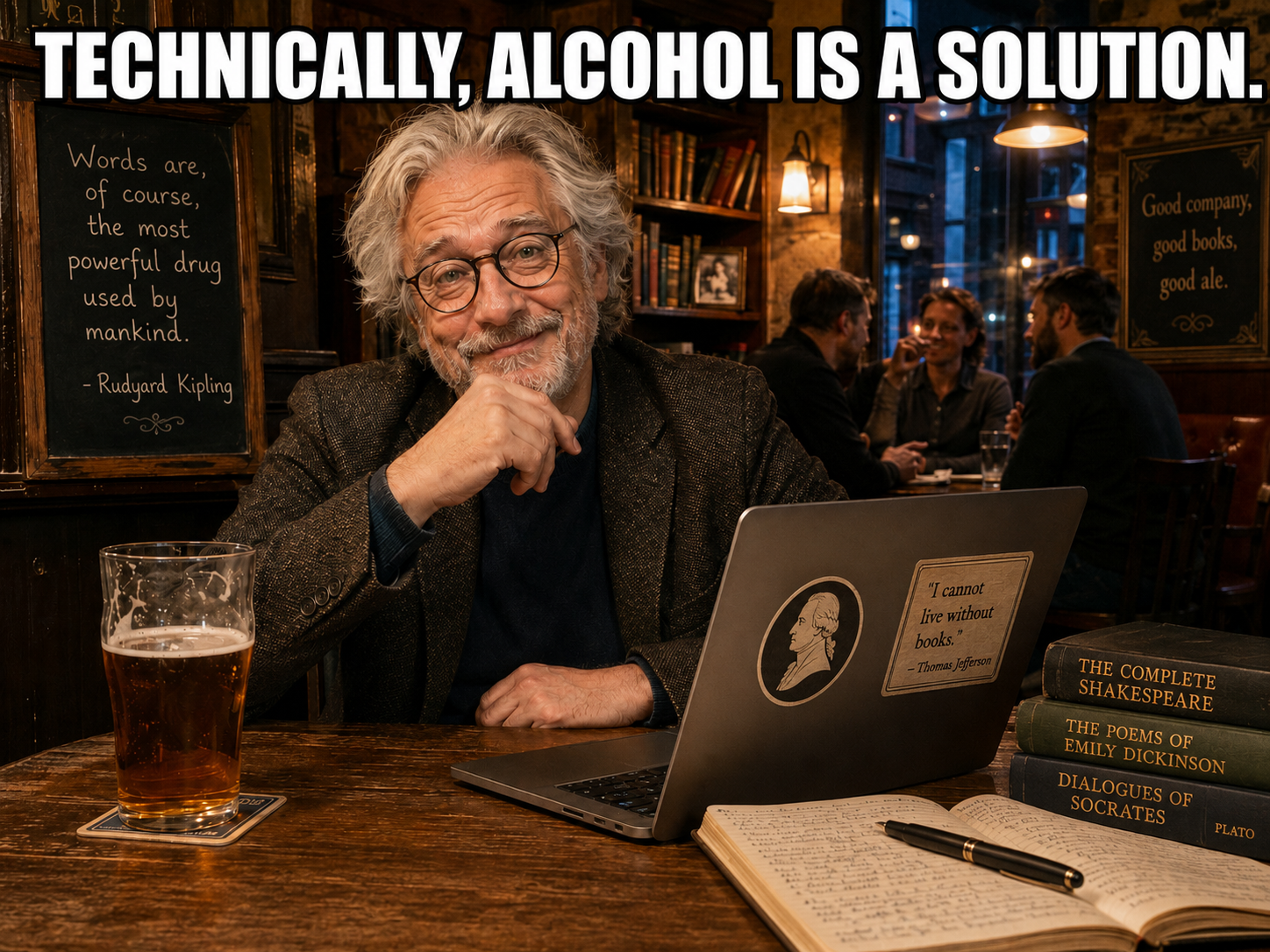
This is a post about booze. That’s all the disclaimer you get. Pull up a barstool and let’s talk.
Back when the Canadian Centre on Substance Use and Addiction released its new guidance on alcohol, I wrote about the devil hiding in the details. Not because I thought alcohol was harmless. It isn’t. Anyone pretending otherwise has either never known a serious alcoholic, never watched a family collapse under the weight of addiction, or never read the side of a hospital chart with the right kind of fear in their stomach.
Alcohol can wreck lives. It destroys livers, marriages, cars, futures, and Saturday mornings. I am not here to argue that alcohol is health food because a Frenchman once lived to ninety-seven while drinking red wine and eating cheese under a tree. Anecdotes are nice, but they make terrible medicine.
Still, I remain suspicious of the new puritanism around alcohol, especially the kind that arrives wearing a lab coat, carrying a spreadsheet, and posting to social media. Yes, I know…
The message increasingly seems to be that no amount of alcohol is without risk, that every drink is a tiny betrayal of your future self, and that the ideal citizen drinks filtered water, sleeps on schedule, wears a smartwatch or ring (guilty!), gets ten thousand steps, monitors every biomarker, and never says anything regrettable at a wedding.
Compelling data. Terrible party.
Public-health people aren’t wrong to talk about risk. They should. That’s their job. But risk isn’t the only thing humans are managing. We are not merely organisms trying to maximise lifespan. We are social animals trying to make life bearable, meaningful, funny, intimate, and occasionally worth dressing up for.
That is where alcohol complicates the story.
Alcohol isn’t just ethanol. It’s ritual. It’s the pint after work, the glass of wine with dinner (or while watching Netflix after the kids go to bed), and the bottle opened because someone got the job, lost the job, survived the week, came home, left home, got married, got divorced, or simply showed up with stories.
It’s the pub table, the kitchen island, the backyard chair, the Legion hall, and the hotel bar where strangers become temporary philosophers. It’s the wedding reception where two families discover they are now related and may need something stronger than tea to process the news.
Alcohol has been a social lubricant for thousands of years. Imperfect? Certainly. Safe? Not always. Powerful?
Damn straight.
Alcohol lowers the drawbridge. It gives the guarded an excuse to loosen up and the lonely a plausible reason to sit near other humans. The shy get a little push, and the over-serious become, for an hour or two, almost tolerable. I said almost.
Stories emerge. Songs happen, some of which might be old TV theme songs. Arguments begin and, if civilization is functioning properly, end with, “Same again?”
This matters because what we lose when we take alcohol out of the equation isn’t just alcohol consumption. We risk losing some of the social architecture that grew around it.
The local pub was never just a place to drink. At its best, it was a low-pressure civic institution. You didn’t need an appointment, a mission statement, or a committee. You didn’t need to download an app, optimise your personal brand, or explain your presence. You could simply be there.
That sounds small until it disappears.
I had been about to write that Frasier Crane first walked into Cheers out of the rain, or loneliness, or whatever it was that day. This was a lovely illustration of my point, marred only by being wrong. Frasier arrived in season three as Diane’s boyfriend and Sam’s psychiatrist. Memory is a notorious drunk.
The larger point survives. Cheers understood that a healthy society needs places where you can be around other people without an agenda. Not work. Not home. Not church. Not an online platform pretending to be a town square while harvesting everyone’s irritation for profit. A real place. A room. A door. A bartender. A few regulars. The possibility of conversation.
The pub offered something that feels increasingly rare: unstructured belonging.
Religion creates community. For many people, it does that extraordinarily well. But religion comes with doctrine, hierarchy, identity, expectation, and a set of rules about what sort of human you are supposed to be. The pub is looser. It doesn’t usually ask you to believe six impossible things before breakfast. It asks whether you want another.
That looseness is the point. Pubs and bars make room for conversation, flirtation, bad jokes, political disagreements, confessions, nonsense, and a little forgiveness. A dash of shared foolishness.
Civilization needs shared foolishness.
This is the part that makes me nervous about our current “alcohol is bad” moment. We are taking apart many of the informal structures that helped people tolerate one another. We work from home and meet through video apps. We shop from home. We watch movies at home. We date through phones. We argue through screens. We avoid places where people gather because they are expensive, inconvenient, loud, risky, awkward, or full of people who might disagree with us.
I could blame it all on the pandemic, but the pandemic didn’t create this trend. It poured accelerant on it. For a while, other people became vectors. Bodies became risks. Gatherings became superspreader events. We learned to live apart, and some of us got very good at it.
Too damn good.
Now add cannabis edibles to the picture. I am not here to scold anyone for using THC gummies. After all, I regularly indulge in my two favourite drugs, caffeine and alcohol. Plenty of people find edibles useful, pleasant, calming, or simply preferable to a drink. Fine.
But a gummy is usually a private ritual. You take it at home. You settle in. You become one with the couch. You watch something. You order something. You do not typically wander down to the local, strike up a conversation with a retired machinist, and end the night debating consciousness with a stranger named Dave.
Same broad category of adult indulgence. Completely different social output.
To be fair, alcohol can isolate people too. Addiction shrinks the world with brutal efficiency, and drinking at home alone is hardly a recipe for civic renewal. The magic isn’t in the ethanol. It’s in the invitation, the room, and the permission to linger. Alcohol has simply been very good at supplying all three.
The pub gets you out of the house. The gummy asks nothing more strenuous than finding the remote.
If we abandon public drinking, we may reduce certain health risks while increasing social isolation. That might look like progress on a spreadsheet while leaving the human animal worse off in practice. Fewer damaged livers, perhaps. More lonely people. More atomised households. More online grievance. More people whose main social contact is a comment thread full of strangers performing certainty for one another.
I am not convinced that is a bargain worth celebrating.
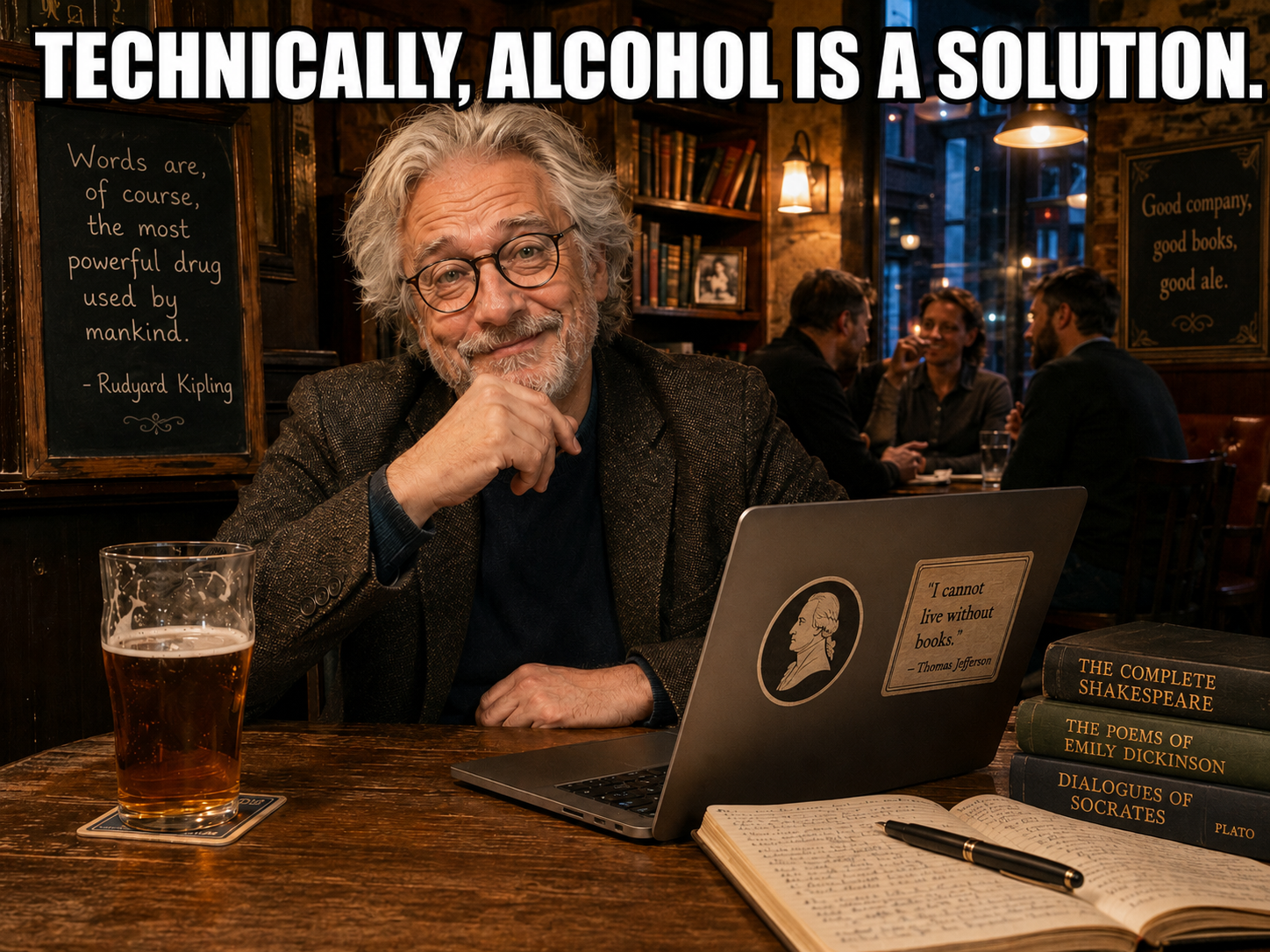
So let me offer some alternative advice.
Stop living as though every imperfect choice were a biohazard. Leave the house. Take a few risks. Be seen. Meet people. As Miss Frizzle was fond of saying, “Take chances, make mistakes, and get messy!” Make the kind of mistakes that can become stories, relationships, careers, marriages, and occasionally children with alarming opinions.
I’m not defending drunkenness. I’m defending exposure. Exposure to people. To chance. To embarrassment. To possibility.
We’ve become very good at avoiding things that are bad for us. Alcohol. Red meat. Carbohydrates. People with opposing political opinions. The trouble is that many good things begin as decisions that look questionable at the time: the party you nearly skipped, the stranger you almost didn’t talk to, the song you should not have sung, the invitation accepted for no better reason than, “Why the hell not?”
A life with no bad decisions isn’t necessarily a wise life. Usually, it’s just a small one.
Which brings me back to the health warnings.
Yes, alcohol increases risk. The evidence has moved against the comforting old story that a daily glass of wine is secretly medicine. It probably isn’t, and I’m willing to accept that. If all you care about is biological risk, the safest amount of alcohol is none.
If all you care about is avoiding injury, never ride a bicycle. If all you care about is avoiding food poisoning, never eat oysters. If all you care about is avoiding heartbreak, never fall in love. If your only goal is to extend life by playing it safe, you may eventually forget what life is for.
The real question is whether we can have an adult conversation about trade-offs without collapsing into either denial or panic.
We should discourage heavy drinking. We should take addiction seriously. We should make impaired driving socially radioactive. We should be honest about cancer risk, liver disease, sleep disruption, violence, and the other costs alcohol imposes. We should make non-alcoholic options normal and good instead of treating them as punishment drinks for designated drivers and the tragically sensible.
But we should also be honest about what alcohol historically provided. It gave people an excuse to gather. It made room for the unplanned. It softened some of the boundaries between strangers, turned buildings into neighbourhood institutions, and helped people linger.
Lingering matters. A society where no one lingers is a society in trouble.
We can talk all we like about social cohesion, but cohesion doesn’t form in policy documents. It forms when people repeatedly encounter one another in low-stakes settings. It forms when you know the bartender, recognize the old couple in the corner, forgive your neighbour for voting differently because he helped push your car out of the snow, and discover that the fellow with the terrible opinions about zoning is also an amazing chef.
That kind of tolerance isn’t taught by slogans. It is brewed slowly, in rooms.
So no, I don’t want to choose between cirrhosis and loneliness. That’s a false choice, and a depressing one.
The challenge is not to defend alcohol as harmless. It’s to defend the social world alcohol helped sustain while being honest about the bill it sometimes presents.
Maybe we can invent better social rituals. Maybe we can build pubs that aren’t centred entirely on drinking. Low-alcohol beer, non-alcoholic wine, late-night cafés, community kitchens, music rooms, maker spaces, neighbourhood clubs, and yes, even cannabis lounges may be able to carry some of the load. I hope so.
But I don’t believe these structures appear merely because we declare them healthier. The local pub evolved over centuries. It accumulated habits, meanings, permissions, and characters. You cannot replace that overnight with a wellness café, a municipal recreation program, and an app-based meetup called “Intentional Adult Friendship Circle.”
That name alone could kill a village. Swipe right for a new friend!
What worries me is that we are dismantling the old machinery faster than we are building anything to replace it.
We have decided, correctly, that alcohol is more dangerous than we wanted to believe. But instead of asking what social role it played, we’ve sometimes treated its decline as an uncomplicated victory. Less drinking. Better health. Case closed.
I’m not so sure.
A society can get physically healthier while getting socially sicker. Loneliness is not a lifestyle preference. Isolation changes people. Social-media bubbles, the pandemic, and remote work have not always brought out the best in us. They can make us anxious, brittle, suspicious, and easier to manipulate. They drive us towards screens that offer connection without intimacy (yes, yes, I can see myself in that mirror, thank you), outrage without courage, and community without obligation.
The pub, bar, or nightclub was never perfect. Sometimes it was ugly. Sometimes it was destructive. Sometimes it was exactly where someone should not be.
But at its best, it was a pressure valve, a commons, and a refuge from the polished loneliness of private life.
We should be careful what we throw away.
The friendly drink isn’t sacred. Unscripted, messy togetherness just might be.
Feel free to have your say in the comments. But until next time, Cheers!