Demons at the Foot of my Bed
I woke up in the dark and they were there; several of them, advancing on me with intent. I don't remember screaming, but I imagine I did. I do remember the terror. It had texture. Weight. The thing about being five (or six) is you don't have the equipment yet to ask whether what you're seeing is what's in the room. You just see, and you believe.
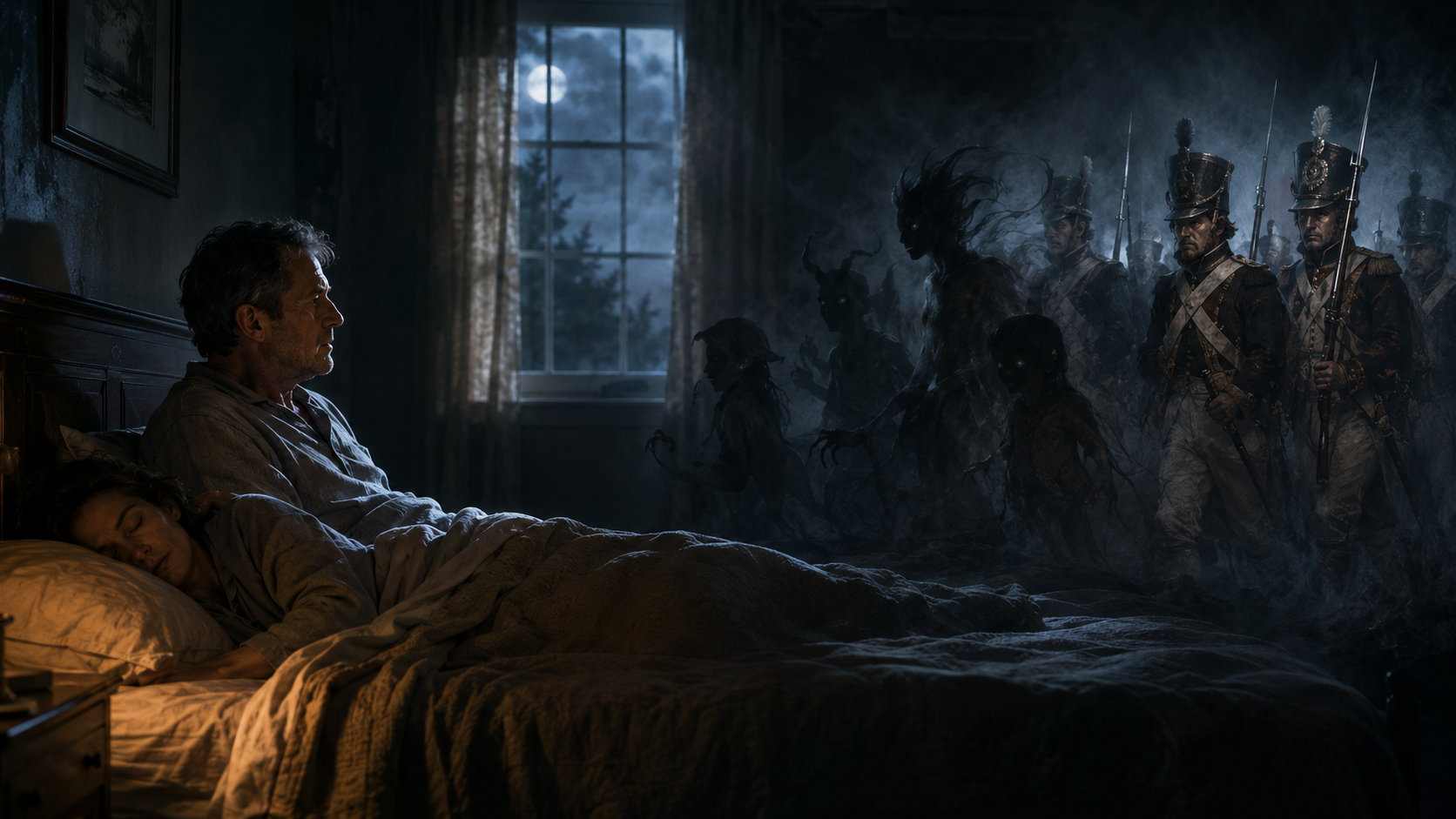
There were demons at the foot of my bed.
I was five, maybe six. We lived in Chicoutimi then, before the move to Alma, before Ontario was anywhere on the map. I woke up in the dark and they were there; several of them, advancing on me with intent. I don’t remember screaming, but I imagine I did. I do remember the terror. It had texture. Weight. The thing about being five (or six) is you don’t have the equipment yet to ask whether what you’re seeing is what’s in the room. You just see, and you believe.
That memory has sat with me for coming up on sixty years. I’m telling you about it now because last summer something almost identical happened, and that time, I had the equipment.
Fast forward sixty years (ish)…
Sally and I were in Nova Scotia. We’d made our way to a small town called Baddeck. Ahh, Baddeck! This is one of those places that doesn’t ask you to like it but won’t let you leave without liking it anyway. Or loving it. We loved it. We did the usual things. The Bell museum. The bay. We took a boat cruise and watched bald eagles catch the fish the tour guides (and crew) threw from the boat. And we ate at Baddeck Lobster Suppers, which you cannot just walk into; you book ahead or you eat somewhere else. Sally had mussels. I had a few of hers, because Sally loves steamed mussels and her enthusiasm is contagious. I typically don’t order them myself, but I always take some of hers.
That detail matters. Hang onto it. But I digress…
That night, we fell asleep early. Long day, full belly, unfamiliar bed — you know, the usual recipe. I don’t know how long after that I woke up, but when I did, I wasn’t quite alone.
Sally was sleeping beside me. That part was real. The other part, the part I want to tell you about, was a battlefield. Soldiers in uniforms that looked maybe a hundred-and-fifty or two-hundred years old. I’m no expert. Oh, and old rifles. Lots of movement and smoke, possibly; I don’t trust the memory on that one. The whole thing was in my bedroom, but not projected onto it the way I usually imagine things. I’m good at visualizing things. I can put a small impish creature on a table and watch it pace, but I always know it’s an overlay (I’m not crazy). Ethereal. Sort of half-there. This wasn’t that. This was solid, three-dimensional, and photoreal. As real as Sally beside me, who was real, because I kept checking.
And here’s the thing I want to flag, because it’s the part that matters most:
I asked myself, in the middle of it, how am I seeing this?
Not what is this, or who sent it. Not what does it mean. How am I seeing this? For whatever reason, I was able to summon the diagnostic question. The skeptical question. The question that does not get asked by a five-year-old waking up to demons.
The hallucination lasted several minutes, faded into something dreamlike, and I lay awake for an hour afterward trying to work out what had happened. The next morning I did some searches and landed on a suspect: domoic acid, a neurotoxin that turns up in shellfish from time to time, infamous for an outbreak in Atlantic Canada in 1987. Hallucinations are on the symptom list. I told Sally. We agreed it was a working theory.
Except, and I owe this to a conversation I had later, the mussel theory has a problem. Sally ate the mussels too. Sally was fine. If a bad mussel got into the batch, the odds of it landing only on my plate are small enough to ignore. The toxicology doesn’t fit.
What fits cleaner is something called a hypnopompic hallucination (say that five times real fast). They happen on the waking edge of sleep when your visual cortex hasn’t fully exited REM, your consciousness is back online, and for a few minutes the two systems run side by side. The result looks like the real world because, in a sense, it’s using the same rendering engine. The image isn’t an overlay. It’s painted directly into the visual field. A quick search suggests these things happen to somewhere between seven and thirteen percent of the population. They’ve been documented since 1664, when a Dutch physician named Isbrand Van Diemerbroeck wrote up the first proper description. Fuseli painted one in 1781 and called it The Nightmare, with a demon squatting on a sleeping woman’s chest. He didn’t invent that image. He documented it. So it’s not rare. Just rarely discussed.
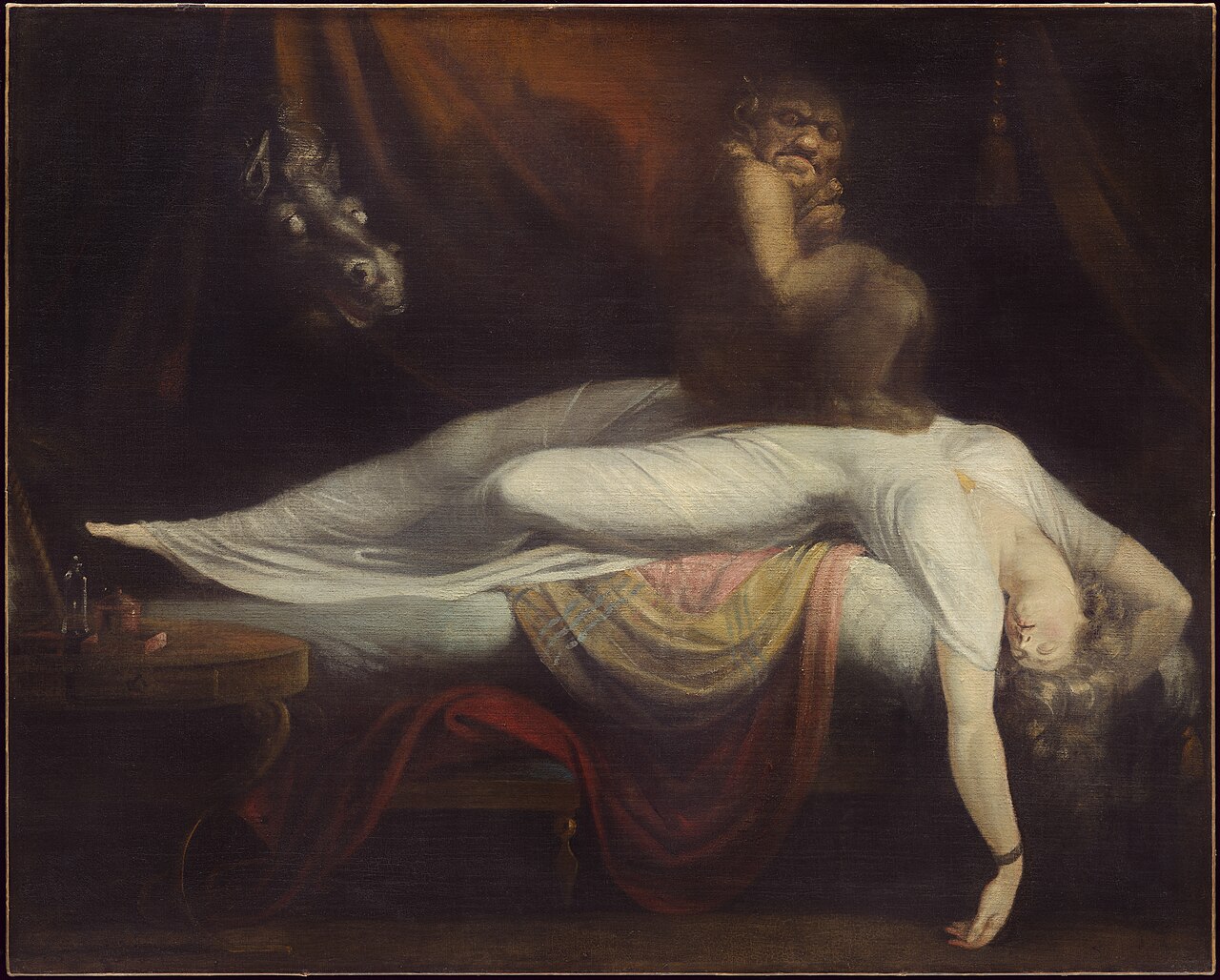
What gets painted, though, and what shows up. is shaped by what’s recently been in the visual cortex (I think I saw something like this in at least one episode of “Fringe”). We weren’t in 19th-century military history that day, specifically. But you don’t have to be. On the East Coast you’re surrounded by history every minute you’re awake. The Atlantic provinces breathe it. The brain catalogues all of it and saves the file for later, and we had been to several historic sites in the last few days.
So, regrettably, the battlefield wasn’t a window in time. It was my own visual cortex doing inventory while I was trying to sleep. Mussels innocent. Verdict: not guilty. Well, dang!
Now back to the demons.
Same phenomenon, almost certainly. Five-year-old me wakes up, visual system still running dream content, threat-detection screaming about ambiguous shapes in a dark room. The brain has to assign those shapes a category. And the category available to small-town 1960s Saguenay was… well… Demons. Demons were a working part of the local cosmology. Catechism saw to that. The iconography in the churches up there was not what you’d call subtle. Hell had a visual program, and that program had a budget.
Sixty-some years on, the same brain (now belonging to an atheist) wakes up to ambiguous shapes and reaches for a different category entirely. Neurotoxin. Sleep stage. Visual cortex. The shapes are still ambiguous, sure, but the interpretive software is, shall we say, a bit more refined.
That’s the thing I keep turning over.
The hardware didn’t update (not much, in the grand scheme of things). The brain that saw demons at five is in most ways the brain that saw soldiers at fifty-something. Same equipment, with the same wiring, and the same vulnerabilities at the edges of sleep. What changed is the operating system, so to speak. Somewhere along the way, I dismantled the worldview I was handed (i.e. religion) and built another one, piece by piece, using the only tools I trusted.
I don’t say that as a flex. I say it because most people never do it. Most people inherit their metaphysics and let it sit. Or sit on it — take your pick. They drift, sure. They stop going to church, soften the edges, declare themselves “spiritual but not religious,” and call it done. Some people go shopping for another mythology. But the underlying furniture stays roughly where their parents put it. The demons stay demons. They just go quiet. Sometimes, the demons turn into aliens, but that probably belongs in another post.
Back to my childhood demons, then. Walking out of the Saguenay version of all that — out of the architecture (though Alma’s Église de Saint-Pierre was very modern looking for its time), the language, the family, the school, the church on every corner — is a longer trip than most atheists make. I don’t think I appreciated until recently how long.
Ask me about seeing Satan in the mirror if you’re hungry for another demon-centric story.
But here’s the thing about growing up. The next time something appears at the foot of my bed, I’ll know what to do.
Assuming I’m in that cool hypnopompic state, I’ll just ask the question.
How am I seeing this?
And then, I’ll try to enjoy the show.