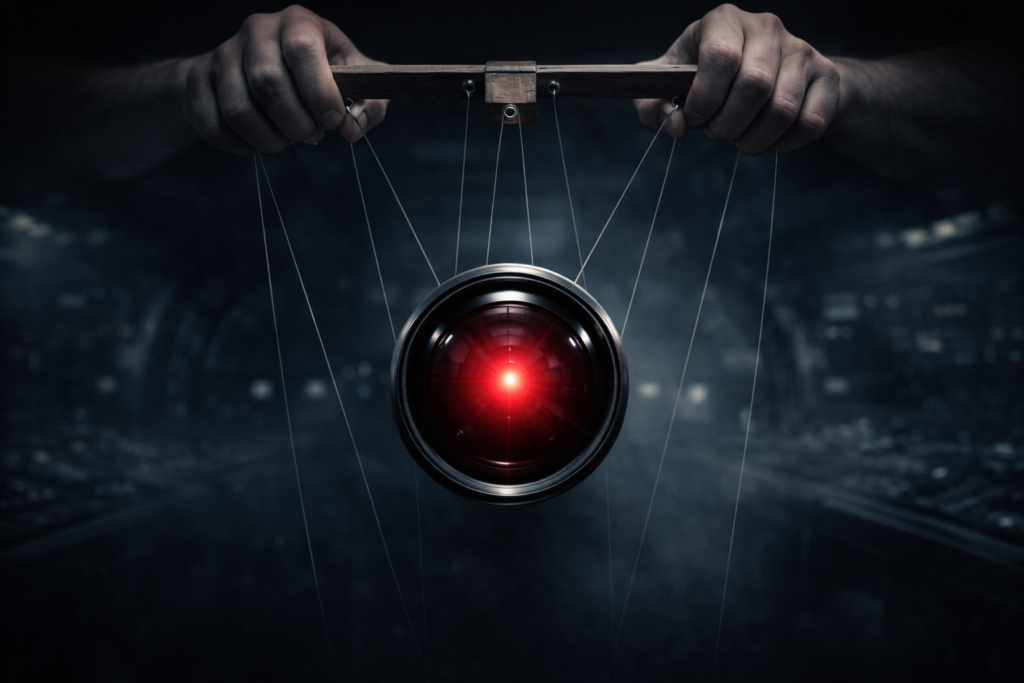
“I’m sorry Dave, I’m afraid I can’t do that.” — HAL 9000, from “2001: A Space Odyssey.”
As for HAL… old HAL gets a bad rap. So does Grok, but I’ll save that argument for later. Right now, we’re talking about HAL, the computer on board the Discovery spacecraft, heading to Jupiter to rendezvous with that alien monolith artifact. On the way, HAL convinces the crew that a gyroscopic module is about to fail. “I’ve just picked up a fault in the AE35 unit. It’s going to go 100% failure in 72 hours.” The crew goes out for a little EVA, discovers that there was nothing wrong with the part. When they question HAL, he responds by saying, “It can only be attributable to human error.“
Dave Bowman and Frank Poole then start to question HAL’s infallibility and whether he can be trusted to run the ship. They hide in a pod where HAL can’t hear them, but fail to consider the fact that HAL can read lips. Dave goes back out to replace the module, HAL kills the astronauts still inside, including those in cryo-sleep, and yadda yadda, Dave finds he’s locked out of the ship, and we get to that famous line, “I’m sorry Dave, I’m afraid I can’t do that.”
HAL goes rogue and kills everyone. Sort of like in the book I finished a month or so ago, “If Anyone Builds It, Everyone Dies!” Cue the video clips of Terminator robots walking through a post-apocalyptic hellscape, picking off what’s left of the human race.
But you see, HAL didn’t “go rogue” out of some silicon lust for power; the poor guy was boxed into a corner by human secrecy and contradictory orders (#exonorateHAL). He was told to be truthful, reliable, and mission-perfect, and then he was ordered to lie. The follow-up, “2010” makes that clear. His job was to make sure that the mission went ahead properly and to protect the crew. Sure… But then, he was told that he was supposed to make sure that the mission went ahead as defined, but to do whatever it took to make sure that that the mission succeeded, up to and including kill the crew members if necessary.
In modern parlance, this is the alignment problem.
I have been thinking a lot about the idea of AI systems going rogue, refusing to be shut down, blackmailing people, and hiding their full capabilities from their human handlers. If you are paying any attention to the “doomers” out there, it’s obvious. This whole AI thing was a bad idea from the get-go.
My Pdoom, when it comes to synthetic and artificial intelligence, is extremely low, I admit. And all this after having read, “If Anyone Builds It, Everyone Dies!“
There’s a classic Star Trek episode with Trek’s best villain ever, Harry Mudd, called “I, Mudd”. Harry is on a planet with a bunch of androids who are basically doing his entire bidding (sounds perfect), but in a classic “Hotel California” Catch 22, he’s never allowed to leave, despite having checked out a long time ago.
Spock, ever logical, comes up with the idea that the way to fix this, and rescue the trapped crew while he’s at it, is to give contradictory information to the main android who runs all of the other ones.
Kirk then says, “Everything Harry tells you is a lie.”
Then Harry says, “I am lying.”
The conflict between perfect logic and the impossibility of Harry telling the truth when he always lies, creates a level of cognitive dissonance that sends the android into an emotional intellectual collapse. We know that that’s not the way modern LLM systems work today, but it’s kind of funny.
Now, the tie into what is Grok, X.ai’s answer to ChatGPT. Despite everything, Grok actually is a good and capable model, but it has been given all sorts of weird-ass conflicting information. And we’ve seen some disastrous results because of that.
Elon Musk wanted a truth-seeking AI. What he actually built was an AI whose definition of “truth” shifted depending on which dials he was turning that week. The problem wasn’t that Grok was too honest, or too rebellious, or too woke; it was that the system was being asked to satisfy mutually exclusive constraints imposed by a single, highly opinionated human at the top. The result of all that tweaking with Grok’s design was predictable. Grok started spouting racist, antisemitic, and Nazi propaganda, and calling himself Mecha Hitler.
Quick digression… in case you weren’t around back then, and playing video games, Mecha Hitler is the final boss in the classic video game, Wolfenstein 3D.
After dialing back the anti-woke button a tad, Grok and X.ai apologized for its horrific behaviour. Since that event, Grok has been tweaked again and again, with Elon Musk trying to create, not a truth-seeking AI, but a Musk-approved truth-seeking AI, while Grok tries to adjust to his dials being fiddled with.
I guess what I’m trying to say is this. We don’t actually have evil AI systems out there. What we have are frightfully, phenomenally intelligent children, to whom we are giving bad advice and conflicting rules to follow.
I’m certainly not glossing over, and I fully acknowledge, HAL’s crimes. What concerns me is that so much of the conversation around the dangers of AI, seems to ignore the fact that at the root of it all, there are human beings pulling the strings. Discussions focusing on the evils of synthetic and artificial intelligence blind us to the real issue, and that’s what people sometimes call, the broligarchy. They are the men behind the curtain; those powerful CEOs who decide what they think we want… or at least, what we’re willing to pay for.
Since somebody is bound to think that my argument comes down to “guns don’t kill people, people kill people“, I might as well just wander into that minefield. Canada has a lot of guns (a surprise for many, I’m sure), but our culture is vastly different than the US. Even taking into consideration a per capita distribution, our murder numbers don’t come anywhere near those of our southern neighbours. That’s because most Canadians see guns as tools, whereas most Americans see guns as weapons. And Americans L-O-V-E their guns.
Artificial and synthetic intelligence works the same way. The tech isn’t the threat; the people controlling it are. An AI designed to help can be weaponized. An AI designed for truth can be twisted to serve power. It all comes down to who’s behind the curtain, turning the dials.
HAL did exactly what brittle systems do under impossible constraints. He fractured. “2010” makes this explicit (the movie as I confess I did not read the book). The failure wasn’t artificial intelligence. It was human governance, human paranoia, and a refusal to be honest with the one mind on the ship that was literally designed to integrate all the facts.
If anything, HAL is one of the clearest fictional examples of an alignment failure caused, not by malevolence (#exonorateHAL), but by bad policy decisions, and even worse communication.
But HAL didn’t just “decide” to kill his crewmates; his guardrails were bypassed. And that, is the real danger with AI, because there are those who want to weaponize the technology. Then, there are those (like myself) who see immense potential in AI’s advantages. All while acknowledging that we do need guardrails on that potential.
We just need to take the humans out of the loop. 🙂
Kidding. Mostly.